Introduction:
In clinical drug development, sponsors may encounter regulatory requests for additional randomized dose-finding studies that disrupt established development plans. In other cases, the justification for a proposed Optimal Dose may fail to meet regulatory expectations, leading to delays in program advancement and reduced development efficiency.
ICH E4 identifies the dose–response relationship as a critical component of the evidence package supporting drug registration. However, the maximum tolerated dose (MTD) is not always the optimal dose. While traditional cytotoxic therapies have historically followed a toxicity-driven MTD paradigm, this approach presents several limitations in the era of targeted therapies. Highly selective agents may never reach an MTD; even when an MTD is identified, it may substantially exceed the dose required for maximal target engagement; and the conventional MTD paradigm does not adequately incorporate PK/PD information to address a fundamental question: what dose is required to achieve sufficient target inhibition?
The FDA's Project Optimus initiative has accelerated the shift in oncology dose selection from a toxicity-driven paradigm toward exposure–response and target inhibition-driven approaches. As a result, establishing and justifying the Optimal Dose has become a key regulatory expectation throughout oncology drug development. Quantitatively derived dose recommendations can provide robust scientific support for regulatory interactions, reducing dose-related uncertainties and facilitating more efficient clinical development.
Serving as a translational bridge between preclinical research and clinical development, quantitative pharmacology modeling integrates pharmacokinetic (PK), pharmacodynamic (PD), and other relevant data to translate preclinical findings into clinically meaningful dose recommendations. By bridging species, endpoints, and sources of variability, it enables the conversion of the concentration required to achieve adequate target inhibition in preclinical studies into the dose required to achieve similar target inhibition in majority of patients. Through the integration of diverse data sources within a PK/PD modeling framework, quantitative pharmacology supports the identification of an optimal dose or dose range with greater transparency and more efficient use of available information than traditional empirical dose-finding approaches.
Tepotinib provides a representative example of this strategy. Through target inhibition-driven translational modeling, a dose of 500 mg once daily (QD) was selected as the Recommended Phase II Dose (RP2D) and subsequently accepted by regulatory authorities. Notably, only the 500 mg QD dose was evaluated in subsequent clinical studies, highlighting the important role of quantitative pharmacology in improving development efficiency and addressing regulatory expectations regarding Optimal Dose selection.
Using tepotinib as a case study, this article explores the role of quantitative pharmacology in establishing recommended doses.
1. Quantitative Pharmacology in the Selection of Tepotinib's RP2D
1.1 Overview of Tepotinib
Tepotinib is an oral, reversible, ATP-competitive, highly selective MET tyrosine kinase inhibitor (TKI). MET exon 14 skipping (METex14) is a clinically relevant oncogenic driver alteration in non-small cell lung cancer (NSCLC) and represents a well-defined single-gene driver event. By selectively targeting the MET signaling pathway, highly selective MET inhibitors can effectively suppress oncogenic signaling and achieve deep and durable antitumor responses.
1.2 Safety and Efficacy Profile of Tepotinib
In the first-in-human (FIH) study, two dose-limiting toxicities (DLTs) were reported under the R3 dosing regimen (continuous once-daily administration). One patient treated with 1,000 mg experienced Grade 3 alanine aminotransferase (ALT) elevation, while another patient receiving 1,400 mg developed Grade 3 fatigue. Notably, the maximum tolerated dose (MTD) was not reached even at the highest once-daily dose of 1,400 mg.
Evidence of antitumor activity was observed in the 500 mg QD cohort of the FIH study. Among the nine patients treated with 500 mg once daily in the R3 cohort, one confirmed partial response (PR) was observed in a patient with MET IHC3+ esophageal cancer. Another confirmed PR was reported in the 1,400 mg cohort in a patient with MET IHC3+ lung cancer, who achieved a progression-free survival (PFS) of 21.8 months. Although the sample size was limited, the confirmed response observed in the 500 mg cohort provided early evidence of clinically meaningful antitumor activity at this dose level.
1.3 Quantitative Pharmacology Supporting RP2D Selection for Tepotinib
In preclinical efficacy studies, tumor growth control was observed across all treatment groups receiving tepotinib at doses of ≥25 mg/kg/day (Figure 1A). The Simeoni tumor growth model was shown to adequately characterize the antitumor effects of tepotinib. Analysis of the relationship between tumor growth inhibition (TGI), a measure of efficacy, and the mean phospho-MET inhibition predicted by the target modulation model indicated that regression of KP-4 xenograft tumors corresponded to approximately 95% inhibition of phospho-MET (Figure 1B).
After correcting for differences in plasma protein binding between mice (2.9%) and humans (1.6%), the tepotinib concentration required to achieve 90% (EC90) to 95% (EC95) of maximal tumor growth inhibition in humans was estimated to range from 390 to 823 ng/mL.
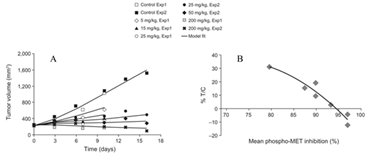
Figure 1. Pharmacodynamic Modeling Results and Corresponding Phospho-MET Inhibition
Population pharmacodynamic simulations were performed using concentrations generated from a population pharmacokinetic (PopPK) model as the driving input and a fully inhibitory turnover Imax model incorporating estimated pharmacokinetic and pharmacodynamic variability. Using sustained and profound phospho-MET inhibition (≥95%) in tumor tissue as the pharmacodynamic target, simulations predicted that a once-daily dose of Tepotinib 500 mg would enable approximately 90% of patients to achieve the predefined pharmacodynamic threshold (Figure 2).
Notably, the predicted levels of phospho-MET inhibition achieved with 500 mg and 1,000 mg once daily were highly comparable, with both doses maintaining ≥95% inhibition in more than 90% of patients. This plateau effect can be explained by the saturable kinetics of receptor occupancy: once the vast majority of available receptors have been occupied, additional drug molecules are unable to engage more targets and therefore provide little or no additional pharmacological benefit.
Although 1,000 mg achieved a level of target inhibition comparable to that of 500 mg, it was associated with an increased risk of dose-limiting toxicity (DLT), including a Grade 3 alanine aminotransferase (ALT) elevation observed in the FIH study. Consequently, 500 mg represents the lowest dose at the efficacy plateau while maintaining an adequate safety margin, resulting in an optimized benefit–risk profile.
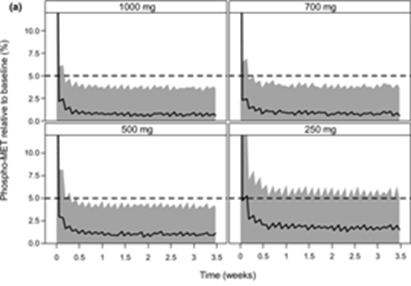
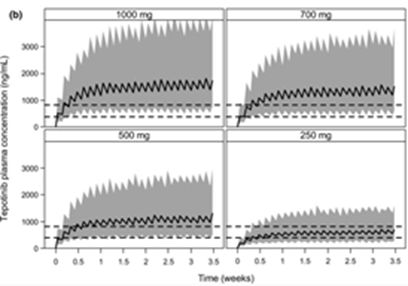
Figure 2. Simulation of Dose-Dependent Phospho-MET Inhibition and Tepotinib Plasma Concentrations in Humans
Panels were arranged from left to right and top to bottom, representing tepotinib doses of 1,000 mg, 700 mg, 500 mg, and 250 mg administered once daily, respectively.
(a) The solid black line represented the median predicted phospho-MET inhibition relative to baseline, and the shaded area represented the simulated 10th–90th percentile prediction interval. The dashed line indicated the pharmacodynamic threshold corresponding to 95% phospho-MET inhibition.
(b) The solid black line represented the median predicted tepotinib plasma concentration, and the shaded area represented the simulated 10th–90th percentile prediction interval. The dashed lines indicated the protein binding-adjusted EC90 (390 ng/mL) and EC95 (823 ng/mL) derived from the preclinical tumor growth inhibition model.
2. Summary
The selection of tepotinib 500 mg QD as the RP2D was supported by a clear and quantitative scientific rationale. Preclinical modeling identified ≥95% phospho-MET inhibition as the threshold associated with tumor regression in the KP-4 xenograft model, while population PK modeling and Monte Carlo simulations predicted that a 500 mg once-daily regimen would enable ≥90% of patients to consistently achieve this pharmacodynamic target. Each step of the dose-selection process was supported by quantitative models and data, resulting in a dose recommendation derived from predefined scientific criteria rather than empirical dose escalation alone.
A key advantage of this approach is that it does not rely on the identification of a maximum tolerated dose (MTD), making it particularly applicable to highly selective targeted therapies with favorable tolerability profiles. By shifting the focus of dose selection from “the highest dose patients can tolerate” to “the dose required to achieve optimal target inhibition,” this strategy reflects a disease biology-driven development paradigm and enables more efficient, precise, and scientifically informed dose optimization.
3. Strengths of Asymchem Clinical's (Clin-Nov) Quantitative Pharmacology Platform
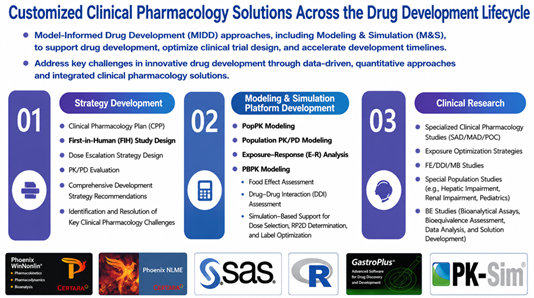
Clinical Pharmacology team of Asymchem Clinical (Clin-Nov) combines expertise in both clinical pharmacology and quantitative pharmacology. This integrated capability enables the team to rapidly identify modeling opportunities arising during clinical development and engage with sponsors in a timely manner, facilitating efficient model-informed decision-making. By reducing delays associated with repeated study background discussions, cross-functional coordination, and resource allocation, modeling activities can be initiated and executed more efficiently.
The close integration of clinical insight and quantitative expertise enables faster decision-making, clinically relevant model assumptions, and more actionable results. Through model-informed approaches, quantitative pharmacology supports more efficient and scientifically grounded drug development.
The most impactful models are not developed in isolation, but through continuous dialogue between clinical understanding and quantitative science.
References:
[1] Falchook GS, Kurzrock R, Amin HM, Xiong W, Fu S, Piha-Paul SA, Janku F, Eskandari G, Catenacci DV, Klevesath M, Bruns R, Stammberger U, Johne A, Bladt F, Friese-Hamim M, Girard P, El Bawab S, Hong DS. First-in-Man Phase I Trial of the Selective MET Inhibitor Tepotinib in Patients with Advanced Solid Tumors. Clin Cancer Res. 2020 Mar 15;26(6):1237-1246.
[2] FDA NDA 214096 Multi-disciplinary Review (Tepotinib). October 30, 2020.
[3] Xiong W, et al. Translational PK/PD Modeling of Tepotinib to Support Human Dose Prediction and Dose Selection. CPT: Pharmacometrics & Systems Pharmacology. 2021;10(5):428-440.